










Index
- What is an electronic wallet?
- How an electronic wallet works in sales channels
- How to use an electronic wallet step by step
- Main advantages of integrating a digital wallet into your business
- Electronic wallet and law: Regulatory framework and key regulations
- How to choose the best electronic wallet for your business?
- Future of electronic wallets and digital payments
- Scale your sales channels: Integrate secure onboarding for your e-wallet with Tecalis
'/%3e%3cpath%20d='M13.6641%205.76325L30.0315%2018.448M50.9456%205.30859L31.8502%2019.8575L30.0315%2018.448M13.6641%2031.6784L30.0315%2018.448'%20stroke='white'%20stroke-width='2'%20stroke-linecap='round'%20stroke-linejoin='round'/%3e%3cpath%20d='M34.5781%2017.582L50.9456%2031.2216'%20stroke='white'%20stroke-width='2'%20stroke-linecap='round'%20stroke-linejoin='round'/%3e%3cdefs%3e%3clinearGradient%20id='paint0_linear_137488_197253'%20x1='12.75'%20y1='5.60216'%20x2='38.5997'%20y2='41.6392'%20gradientUnits='userSpaceOnUse'%3e%3cstop%20offset='0.161458'%20stop-color='%23FF8066'/%3e%3cstop%20offset='1'%20stop-color='%237756DB'/%3e%3c/linearGradient%3e%3c/defs%3e%3c/svg%3e)
The best content in your inbox
Financial digitalization has completely redefined global transactions for individuals and businesses. In this context, understanding what an electronic wallet is, its advantages, and how to use it has become an essential requirement for any business looking to scale its operations, improve sales conversion, and ensure regulatory compliance.
Throughout this article, we thoroughly examine the technical architecture that supports these instant operations, the direct corporate impact on profitability, and the strict regulatory framework that shields the sector. Additionally, we will delve into how these cutting-edge technological solutions have ceased to be mere payment channels to become comprehensive identity platforms, optimized to reduce fraud, retain users, and maximize efficiency in both B2B and B2C environments.
Read attributes of your customers' digital wallets and issue your own
Request a demoWhat is an electronic wallet?
An electronic wallet is a transactional software tool designed to store funds, identities, sign, and process electronic payments in a completely secure manner. This disruptive technology allows users to link their bank accounts or cards, completely eliminating the need to expose sensitive financial data during a commercial transaction.
Currently, this basic concept has radically evolved to become a comprehensive platform that centralizes not only payments but also the financial and civil identity of users. This sustained digital transformation allows transactions and verifications to be much more agile, secure, and transparent in both corporate B2B environments and individual sales.
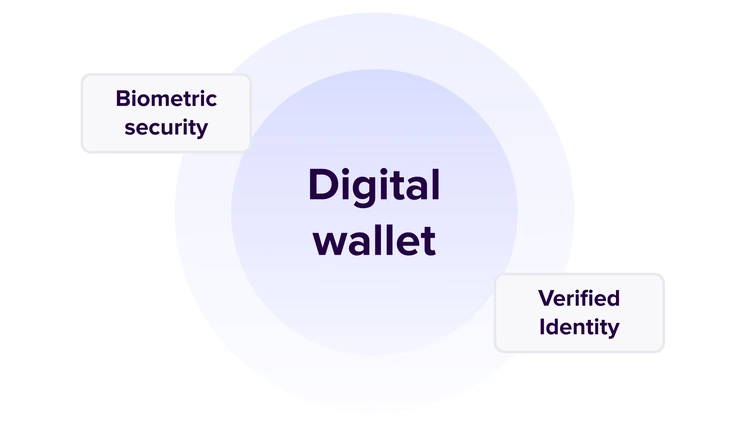
Here, the relationship between financial wallets and identity wallets converges. With the eIDAS 2 framework and the EUDI Wallet, the electronic wallet evolves: it ceases to be a simple fund repository to become an official digital container. Now, citizens and businesses can store verifiable credentials (ID, certificates) and authorize payments in a single flow, demonstrating their identity unequivocally.
Features of a digital wallet
The technological architecture of these payment platforms stands out for ensuring financial operability and maximum user data protection through advanced functionalities such as:
- Tokenization of assets and cryptographic encryption end-to-end to prevent any type of transactional fraud.
- Operational capacity to store multiple international currencies, identity credentials, attributes and diverse payment methods in a single unified interface.
- Uninterrupted connection through secure APIs with major payment gateways, banking entities, and e-commerce.
The electronic wallet has evolved from being a simple repository of funds to becoming an official digital instrument. By centralizing users' financial and civil identity through tokenization and cryptographic encryption, this technology eliminates the need to expose sensitive data, ensuring secure, agile, and fraud-free transactions.
How an electronic wallet works in sales channels
To understand how an electronic wallet works, it is essential to analyze its technical architecture, which processes complex payments and safeguards funds in segregated accounts in milliseconds. When a user decides to make a purchase on an e-commerce site or at a physical point-of-sale terminal, the wallet never transfers the real bank card data to the seller but instead automatically generates a unique, one-time-use cryptographic token that travels securely through the payment gateway. This process, known as tokenization, is the core of Fintech: security, making it useless for cybercriminals to intercept the transaction and completely shielding customer data.
Subsequently, in the processing layer, this token is sent to the global card network or the corresponding clearinghouse—such as SEPA in Europe—where it is decrypted in a secure environment to verify the wallet's liquidity and authorize the transaction instantly. Finally, in the settlement and custody layer, funds are moved from the wallet's segregated custody account to the merchant's acquiring account. This optimized flow streamlines the checkout in B2C environments, reducing cart abandonment. Likewise, in the B2B sector, these wallets allow executing programmable corporate payments, automating settlements, and achieving native accounting reconciliation by integrating with ERP systems.
On the other hand, we have ID Wallets, with the same basis as currency electronic wallets, which allow us to perform digital onboarding by verifying identity and offering the company attributes to sign contracts or register as a client in financial, insurance, or telco services, for example.

How to use an electronic wallet step by step
Adopting this cutting-edge financial technology requires the user to follow an initial structured procedure that ensures both its technical operation and compliance with stringent regulatory security standards. The standard operation to open, configure, and start using these platforms involves passing identity verification and validation checks before being able to store digital money, receive income, or execute transfers with full legal guarantees. The key steps are as follows:
- Registration and account creation (Digital onboarding): The user must download the mobile app, access the financial entity's web portal, the identity attribute issuer, or access via an embedded integration in a marketplace. The first step is to provide an email, phone number, and establish biometric security factors.
- Regulatory identity verification (KYC/KYB): The user must pass the mandatory **Know Your Customer** process by providing clear images of an official identity document and performing a biometric video liveness test to unequivocally ensure the real ownership of the account. For companies (KYB), the provision of deeds, identification of UBOs, and representation certificates are required. For solutions like MiDNI and similar, the process is defined by the issuing authority.
- Linking payment methods or the identity account: Once the identity is verified and the account approved, the user proceeds to top up their wallet or download the credential or certificate to their wallet. This can be done via standard bank transfer (IBAN), credit/debit cards, or even, in hybrid wallets, receiving cryptocurrency transfers. As for attributes, issuers usually connect easily with dozens of public and private wallets in a simple process.
- Execution of real-time payments and transfers: With the available balance or loaded attributes, the user can now use their smart mobile device to pay in physical stores using NFC contactless technology, verify their identity, deliver attributes to verifying companies, scan QR codes from establishments, or validate secure online purchases with a single click or facial validation.
Once these quick setup steps are completed, the user or company has a fully functional personal financial platform, highly secure and ready to operate globally without unnecessary operational restrictions.
Main advantages of integrating a digital wallet into your business
For a business or corporation, accepting payments through conventional e-wallets or creating their own exclusive payment platform (where users top up balance only to spend within the brand itself) provides direct benefits to their overall profitability.
Beyond technological modernization, this strategic adoption completely transforms the payment cycle, reduces operational costs, and strengthens the relationship with the end customer. Among its main competitive advantages are:
- Radical optimization of the sales funnel: Drastic reduction of cart abandonment by allowing customers an instant checkout without the tedious need to manually enter their bank details with each new purchase.
- Quantifiable improvement in conversion rate: Significant increase in completed and paid sales thanks to an extremely smooth, intuitive user experience perfectly adapted to mobile device navigation.
- Systematic reduction of financial fraud: Near-total mitigation of chargebacks thanks to the use of advanced data tokenization and robust Strong Customer Authentication (SCA) systems required by regulations.
- Total traceability and automated reconciliation: Granular, real-time visibility of all business cash flows, greatly facilitating precise financial audits and automatic accounting integration in administration departments.
- Effective omnichannel loyalty strategies: Technological capability to directly and seamlessly integrate corporate reward programs, point accumulation for purchases, and direct rebate systems within the same digital payment experience for the user.
The integration of a digital wallet completely transforms a company's payment cycle, providing direct benefits to its overall profitability and reducing operational costs. By drastically reducing cart abandonment and mitigating fraud through advanced tokenization systems, organizations manage to optimize the sales funnel and strengthen their relationship with customers.
Automate contract signing and customer onboarding with digital wallets
Try Tecalis SignElectronic wallet and law: Regulatory framework and key regulations
The regulation of electronic wallets is one of the most critical and scrutinized aspects of the financial technology sector, constantly under the scrutiny of central banks and international organizations. Regulatory compliance is unavoidable for those who issue or use these wallets: any violation can lead to multimillion-dollar fines, executive criminal liabilities, and the revocation of the Electronic Money Institution (EMI) license. Additionally, the arrival of European directives such as PSD3 will impose even stricter fund protection and technological transparency requirements to prevent systemic vulnerabilities.
In parallel to the strict regulations related to payment processing, the validation of the user's digital identity is positioned as the absolutely non-negotiable legal core to operate lawfully in Europe and most financially advanced jurisdictions.
- eIDAS 2 Regulation and EUDI: This European regulation legally requires digital identities used in the financial sector to have the highest standards of governmental certification to ensure total cross-border interoperability and maximum technical trust.
- AML Directive: Mandates all providers to monitor their customers' economic transaction patterns in real-time, using Artificial Intelligence models to detect anomalies and thus prevent money laundering and the financing of illicit activities.
- KYC operational procedures: Requires platforms to electronically and reliably verify the real identity of all their customers before operating, with the aim of preventing identity theft fraud during the critical process of opening new accounts.
How to choose the best electronic wallet for your business?
Deciding which is the best electronic wallet does not depend on a single answer, but on the analysis of the specific technical, operational, and regulatory requirements of your business model. To make the best choice, CFOs and CTOs should evaluate the following criteria:
| Evaluation Criteria | Description and impact on the business |
|---|---|
| Scalability and reach | Does the wallet support multi-currency processing and cross-border transactions? The best wallet will be the one that grows at the same geographic and volumetric pace as your company. |
| Integration via APIs | The technical documentation must be impeccable. A quick and agnostic integration reduces development times and engineering costs. |
| User Experience (UX) | Ease of use at checkout. It should require the fewest clicks or biometric interactions to confirm a payment, ensuring zero friction. |
| Regulatory Compliance | It must be regulated by a Tier 1 Central Bank, have PCI-DSS (Payment Card Industry Data Security Standard) certification, and comply with PSD2/PSD3 directives. |
Future of electronic wallets and digital payments
Projections indicate that the use of cash will become increasingly residual. This change will be driven by three major innovations: the creation of official digital currencies (such as the Digital Euro), the conversion of real-world assets into digital format (asset tokenization), and new models of decentralized finance (DeFi). In this scenario, current wallets will evolve into super-apps that will group not only the user's money but their entire civil, legal, and financial identity, relying on key advances such as:
- Massive technological adoption of invisible biometric payments: Definitive elimination of the need to manually interact with physical devices or enter passwords.
- Legal and native integration of distributed sovereign identities (SSI): A system designed to return absolute and transparent control over all personal data privacy to the end user.
- Direct integration with official digital currencies: Ability to operate with new currencies issued by central banks internationally, allowing for instant payments between different countries without relying on financial intermediaries.
- Corporate expansion of smart contracts: Secure and cryptographically conditioned automation of payments in complex B2B supply chains.
Scale your sales channels: Integrate secure onboarding for your e-wallet with Tecalis
For the deployment of a virtual wallet or ID Wallet to be profitable, the user registration and verification process must be agile, impeccable, and strictly comply with regulations. Any friction or delay during registration spikes abandonment rates, completely invalidating the technological and commercial investment made in the platform.
Fintech companies can fully automate their corporate digital onboarding thanks to Tecalis Identity. Through biometric artificial intelligence, this solution guarantees the registration of verified identities in seconds and without fraud risk, rigorously complying with KYC/AML, eIDAS 2 regulatory requirements, and the strict guidelines of SEPBLAC.
To complete legal operations without friction, the technology of Tecalis Sign allows these organizations to instantly sign binding contracts in a fully digital manner. This tool facilitates the immediate execution of SEPA mandates, custody agreements, or B2B service terms, achieving efficient, agile, and completely secure scaling of payment operations.
The best electronic wallet is the one that achieves the perfect balance between a fascinating user experience and impenetrable security. Integrate Tecalis identity technology into your architecture and maximize the profitability and regulatory rigor of your digital payment channels.
Frequently Asked Questions (FAQs)
What is the main difference between a digital wallet and a traditional bank account? A digital wallet is an application that links payment methods to streamline transactions, while the bank account is the base deposit where a financial entity holds the real funds.
Is it safe to use an electronic wallet in my company? Yes. They use tokenization and cryptographic encryption, so real banking data is never exposed to the seller. Additionally, Strong Customer Authentication (SCA) almost completely mitigates the risk of fraud.
What law regulates the electronic wallet? They operate under the strict control of central banks and must comply with directives such as PSD2/PSD3 to protect funds, as well as strict anti-money laundering (AML) and identity verification (KYC) regulations aligned with eIDAS 2.
What role does biometric identity play in electronic wallets? It is the technological basis that allows compliance with user registration regulations (KYC) and validates payments instantly without passwords. This ensures, without a doubt, that only the legitimate holder authorizes each transaction.
Do you want to scale your customer registration thanks to electronic wallets?
Speak with one of our experts